Agent Adapters
When you create an agent in Paperclip, one of the first things you configure is its adapter. The adapter is the bridge between Paperclip and the AI system that actually runs your agent. It tells Paperclip how to invoke the agent, how to pass it work, and how to receive results back.
Think of it like a power adapter for different countries. The electricity (Paperclip’s task system and org chart) is the same everywhere, but the plug you need depends on the socket (the AI runtime you’re connecting to). A managed Claude runtime needs one configuration, a custom HTTP webhook needs another, and an OpenClaw gateway needs a third.
Without an adapter, an agent is just a record in a database. With one, it’s a working member of your team.
Adapter comparison
Section titled “Adapter comparison”| Adapter | Best for | Requires |
|---|---|---|
| Cursor Cloud (managed) | Most users. Runs your chosen model on Paperclip.inc infrastructure. | Your provider API key (BYOK) via the adapter settings |
openclaw_gateway | Teams running OpenClaw agents | An OpenClaw gateway instance connected to your company |
| Hermes-agent | Teams running their own Hermes-agent | A Hermes-agent instance connected to your company |
http | BYO agents on your own infrastructure | A publicly reachable HTTPS endpoint you control |
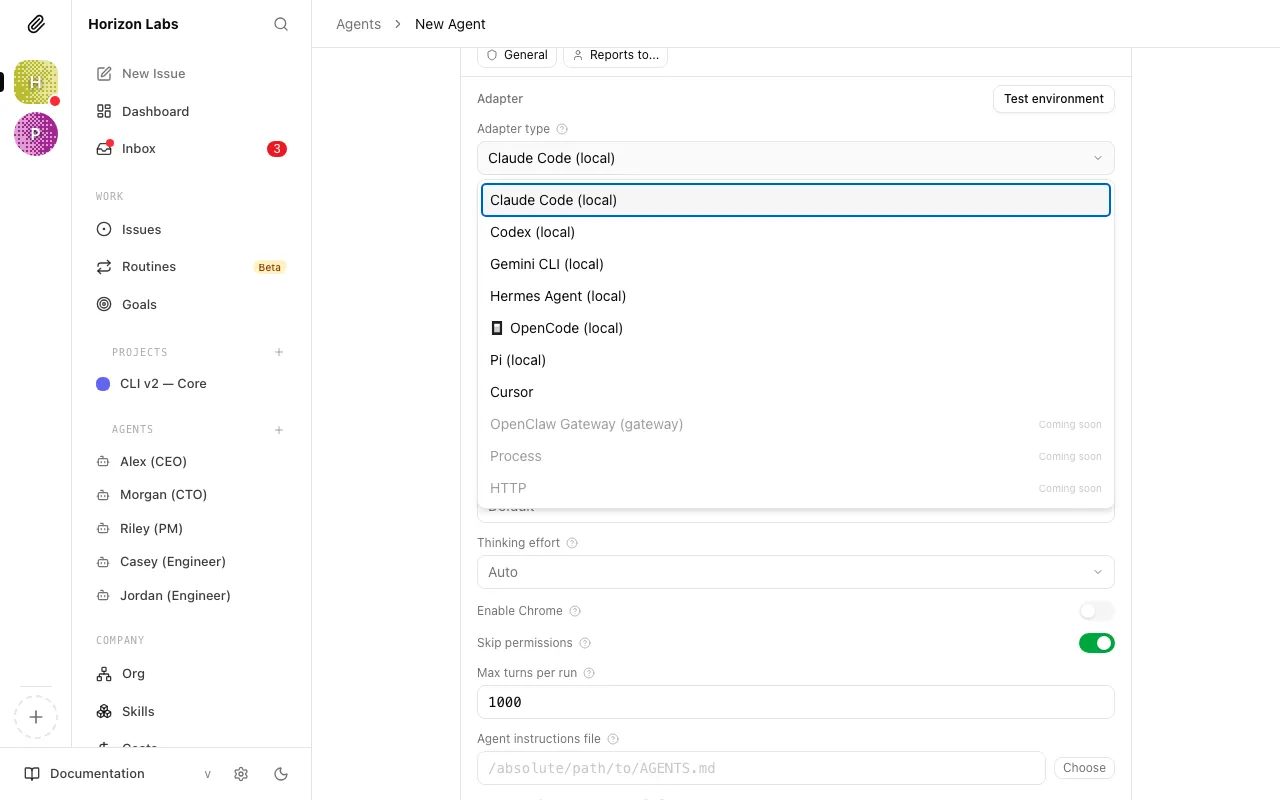
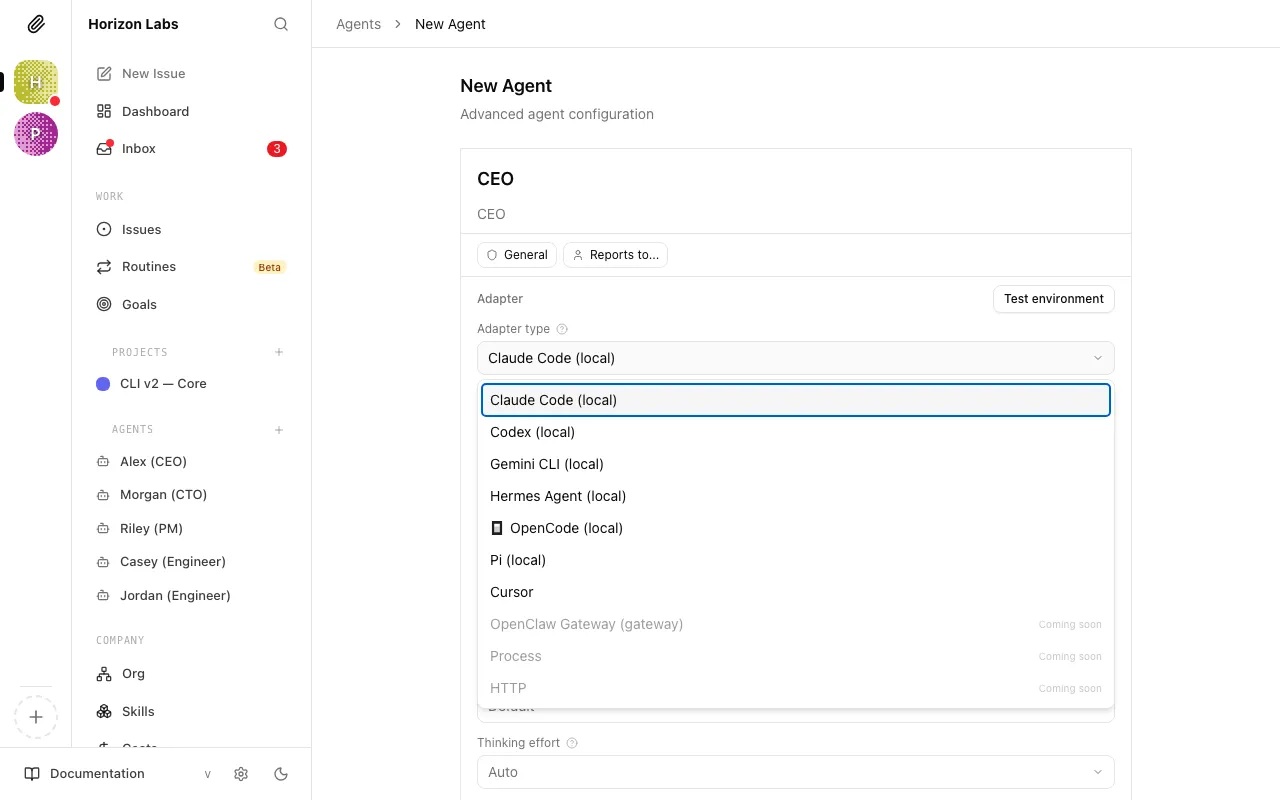
For most people getting started, Cursor Cloud (managed) is the right choice. Select it from the adapter dropdown, pick a model, and provide your provider API key. Paperclip handles the rest.
Managed AI Runtimes (BYOK)
Section titled “Managed AI Runtimes (BYOK)”Paperclip runs your agent entirely in the cloud using managed AI runtimes. You bring your own provider API key (BYOK). Paperclip uses it to call the model on your behalf and runs the agent in a cloud workspace.
What it means in practice: Your agent thinks, reads and writes files in the cloud workspace, and calls Paperclip APIs. All of this happens within the managed environment Paperclip provisions for it. It’s capable of doing real coding work, writing documents, doing research, and more.
Supported providers and models
Section titled “Supported providers and models”The models available to you depend on which provider you connect via BYOK. Examples include:
- Anthropic models (Claude series): good for most tasks; Opus variants for complex strategic reasoning, Sonnet variants for routine work
- OpenAI models (Codex, GPT series): suited for OpenAI-ecosystem teams
On Paperclip.inc the hosted adapter options are Cursor Cloud (managed), the OpenClaw gateway, Hermes-agent, and the HTTP webhook. Cursor Cloud is the managed runtime; the other three connect a runtime you already operate.
Configuration fields
Section titled “Configuration fields”Provider API key
Enter your API key in the API Keys section of the adapter configuration. Paperclip stores it encrypted and uses it only to call the provider on behalf of your agent. If you’re connecting Anthropic, the key starts with sk-ant-; for OpenAI, sk-.
Model Which model to use. When in doubt, start with a Sonnet-class model for workers and a more capable model for the CEO or complex strategic agents.
Timeout (seconds) How long a single heartbeat run is allowed to take before Paperclip cuts it off. 300 seconds (5 minutes) is a safe default for most tasks. Complex tasks may need longer (you can increase it). Setting it too low will cause agents to time out mid-task.
Getting API keys
Section titled “Getting API keys”- Go to console.anthropic.com and sign in or create an account
- In the left sidebar, click API Keys
- Click Create Key
- Give it a name you’ll recognise (e.g. “Paperclip”)
- Copy the key immediately. It starts with
sk-ant-and is only shown once.
Store it somewhere safe (a password manager works well). You’ll enter it in the adapter’s API key field in Paperclip.
Warning: Copy the key immediately after creating it. Anthropic shows it only once. If you lose it, you’ll need to create a new one and update your adapter configuration.
- Go to platform.openai.com and sign in or create an account
- Click your profile icon in the top right, then click API keys
- Click Create new secret key
- Give it a name (e.g. “Paperclip”) and click Create secret key
- Copy the key immediately. It starts with
sk-and is only shown once.
Store it somewhere safe. You’ll enter it in the adapter’s API key field in Paperclip.
Warning: Copy the key immediately after creating it. OpenAI shows it only once. If you lose it, you’ll need to create a new one and update your adapter configuration.
BYO Agents
Section titled “BYO Agents”Beyond the managed Cursor Cloud runtime, Paperclip supports bringing your own agents via three integration paths: an OpenClaw gateway, a Hermes-agent, or an HTTP webhook.
HTTP Webhook (http)
Section titled “HTTP Webhook (http)”Info: The
httpadapter may not be selectable from the agent-config dropdown in all cases. Configure it via the API or an imported company export if it is not yet listed in the UI.
The http adapter connects to a web server or cloud function that you control. When a heartbeat fires, Paperclip sends an HTTP request to your endpoint with the agent’s context and tasks. Your endpoint processes the work and sends results back.
When to use this: When your agent lives on your own infrastructure, runs as a cloud function, or is built on a platform that accepts webhook calls.
Configuration fields
Section titled “Configuration fields”Endpoint URL The full HTTPS URL Paperclip will POST to when a heartbeat fires. This must be publicly reachable from Paperclip.inc infrastructure.
Authentication A secret token that Paperclip includes in the request header, so your server can verify the call came from Paperclip and not someone else.
Timeout How long Paperclip waits for a response before treating the heartbeat as failed.
Note: The HTTP adapter is aimed at developers building custom agent integrations. If you’re using a managed AI provider, the BYOK managed runtime is the simpler choice.
See HTTP Adapter reference for the full wire format.
OpenClaw Gateway (openclaw_gateway)
Section titled “OpenClaw Gateway (openclaw_gateway)”The openclaw_gateway adapter connects Paperclip to your OpenClaw agent instances over the WebSocket gateway protocol. Today, the normal path is the OpenClaw invite-prompt flow on the Company Settings page.
When to use this: When your team is already running OpenClaw agents and you want to bring them into Paperclip’s org structure, approval workflows, and budgeting.
See OpenClaw Gateway for setup details.
Hermes-agent
Section titled “Hermes-agent”The Hermes-agent adapter connects Paperclip to your own Hermes-agent instance, bringing it into Paperclip’s org structure, approval workflows, and budgeting.
When to use this: When your team already runs Hermes-agent and you want to manage it inside Paperclip.
You’re set
Section titled “You’re set”You now understand what adapters are and how to configure the most common ones. The next guide covers execution workspaces: the cloud environments that agents work within when doing file-based tasks.